




Research the Rootthe Microbiome + Geographic TongueIssue 9.0
What You Need to Know About Geographic Tongue
Learn what geographic tongue is, how it connects to the oral and gut microbiomes, and why recurring tongue changes can be part of a larger microbial pattern.
Read the full article
What You Need to Know About Geographic Tongue
Have you ever looked at your tongue or your child’s tongue and noticed a smooth red patch surrounded by an irregular white border?
Did that patch disappear, only for another one to appear somewhere else a few days later?
If you searched for answers, you were probably told it was geographic tongue and that it was harmless.
What you need to know is that geographic tongue is usually benign. It isn’t contagious, it isn’t caused by poor oral hygiene, and it isn’t cancer.
But benign doesn’t mean meaningless.
Calling it harmless answers whether the patches are dangerous. It doesn’t explain why the surface of the tongue is repeatedly becoming inflamed, losing its texture, healing, and then changing again.
And because the tongue is the first visible part of the digestive tract, geographic tongue deserves a larger conversation about the oral microbiome, the gut, immune activity, minerals, and the environment surrounding that tissue.
What Geographic Tongue Actually Is
Geographic tongue is also called benign migratory glossitis.
The surface of your tongue is covered in tiny structures called papillae. In geographic tongue, some of the filiform papillae temporarily disappear, leaving behind smooth red areas surrounded by raised white or pale borders.
The patches can change in shape and size. One area heals while another develops, creating the moving, map-like pattern that gives geographic tongue its name.
Some adults and children never feel it.
Others experience burning, tenderness, or sensitivity, especially when eating acidic, spicy, salty, or very hot foods.
Geographic tongue isn’t an infection. And it isn’t oral thrush, although yeast overgrowth and geographic tongue often exist at the same time.
Not Knowing the One Cause Doesn’t Mean There’s No Biological Context
Research hasn’t identified one universal cause of geographic tongue.
But that’s very different from saying it happens for no reason.
Geographic tongue has been studied alongside psoriasis, allergic conditions, anxiety and emotional stress, hormonal changes, celiac disease, nutritional status, and changes within the oral microbiome.
What they have in common is that they influence the environment surrounding the tongue, including immune activity, inflammation, saliva, nutrients, tissue renewal, and the microorganisms living in the mouth.
The tongue isn’t just changing cosmetically.
It’s participating in a microbial and inflammatory environment that researchers are still working to understand.
Your Tongue Has Its Own Microbiome
Your tongue is covered in microorganisms.
When that community is in balance, those organisms live together, compete for space, interact with saliva, and help protect the tissues of the mouth.
Researchers comparing adults with geographic tongue to adults without it found distinct differences in their lingual bacterial communities. Certain bacterial groups were more abundant while others were reduced.
A more recent pediatric study found that children with geographic tongue also had a significantly different lingual microbiome than children without it.
Neither study proved that one specific bacterium causes geographic tongue. The adult researchers also couldn’t determine whether the microbial shift helped create the lesions or developed because the tissue had already changed.
But both studies tell us something really important…
Geographic tongue isn’t occurring on a microbially neutral surface. It’s appearing within an oral ecosystem that’s different from the one observed in people without those patches.
That changes the question.
Instead of asking which single organism caused the tongue to change, we can begin asking what changed the environment in which those organisms and tissues are living.
Your Mouth Isn’t Separate From Your Gut
The mouth isn’t a waiting room outside the digestive system.
It’s the beginning of it.
The oral and intestinal microbiomes aren’t identical, but they’re directly connected. Every day, saliva, microorganisms, food compounds, and microbial metabolites move from the mouth into the digestive tract.
The gut and mouth also participate in shared immune and inflammatory communication.
Research into the oral-gut microbiome axis shows that oral microorganisms can reach the gastrointestinal tract, and that this movement can become more significant when the intestinal microbiome is already imbalanced.
This doesn’t mean you can diagnose the condition of the gut by looking at the tongue.
But it also doesn’t make sense to talk about a recurring microbial and inflammatory change at the beginning of the digestive tract as though it has nothing to do with the rest of digestion.
This becomes especially important when geographic tongue appears alongside other symptoms like constipation, reflux, bloating, food reactions, eczema, chronic allergies, recurring infections, nutrient deficiencies, autoimmune conditions or other signs that the wider microbial environment is compromised.
The Gut Connection Can Exist Without Obvious Digestive Symptoms
One small case-control study examined 60 people with geographic tongue and 60 people without it.
Nine of the 60 participants with geographic tongue tested positive for celiac-related antibodies and had biopsy findings consistent with celiac disease.
Only two of those nine people reported gastrointestinal symptoms.
This doesn’t mean geographic tongue is a celiac diagnosis but it does show why the absence of stomach pain, diarrhea, or obvious digestive symptoms doesn’t always mean the gut is functioning optimally.
The tongue can be one of the places an internal immune or nutritional pattern becomes visible.
If geographic tongue appears alongside poor growth, anemia, ongoing digestive symptoms, unexplained nutrient deficiencies, or a family history of celiac disease, that complete pattern needs to be looked at.
Minerals Matter, but Geographic Tongue Isn’t One Simple Deficiency
The tissues covering the tongue renew rapidly and depend on adequate nutrients and minerals.
A small study comparing people with and without geographic tongue found lower salivary zinc levels in the geographic tongue group. It didn’t find the same difference in iron or vitamin B12.
That doesn’t prove zinc deficiency causes geographic tongue, and taking one supplement doesn’t restore an entire microbial or nutritional environment.
But it does remind us that tissue health depends on more than what someone eats.
The digestive system has to break food down, absorb its nutrients, and make those nutrients available to the body. And the microbiome participates in that process.
An adult or child can eat a nutrient-dense diet and still struggle to use everything that diet provides when the gut is imbalanced.
Stress Is Part of the Environment Too
The relationship between geographic tongue and stress is sometimes dismissed because stress sounds less tangible than a vitamin level or laboratory result.
But stress changes the body physically.
It changes saliva, digestion, intestinal motility, stomach acid, sleep, immune activity, and the microbial environments of both the mouth and gut.
Research has found an association between geographic tongue and anxiety, although that doesn’t mean anxiety is the cause of every case.
It means the nervous system belongs in the conversation along with everything else we have discussed in this article.
And it’s one reason a complete approach to rebalancing includes nervous-system support instead of focusing exclusively on supplements.
Rebalancing Changes the Environment Instead of Chasing the Patch
Geographic tongue isn’t one proven infection that can be solved by killing one organism.
And because the patches often disappear and return on their own, making one patch temporarily go away doesn’t tell us that the environment underneath it has changed.
The ōnlē Gut Rebalance Method addresses the wider microbial environment throughout the body.
Cleanse clears the bad bacteria, excessive yeast, mold, fungus, and parasites contributing to microbial imbalance while preserving the beneficial bacteria the body needs.
Nourish replenishes beneficial bacteria. These organisms don’t simply introduce the strains inside the capsule. They enter the gut, interact with the microbial community already living there, and help beneficial bacteria that have become depleted grow back in abundance.
Bind supports the body in carrying out toxins, heavy metals, waste, overgrowths, and the unwanted material being released throughout the process.
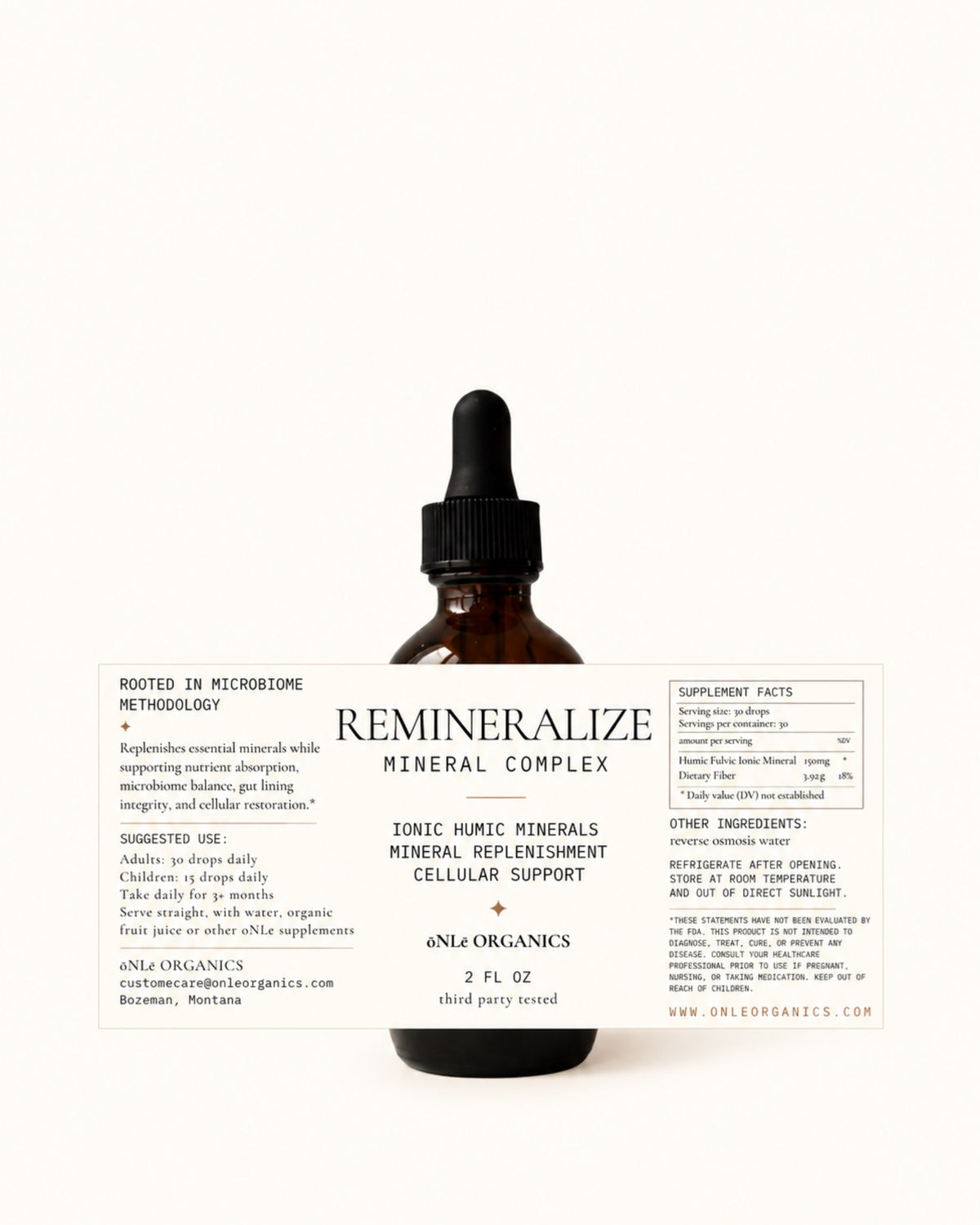
Remineralize restores essential minerals supporting tissue renewal, hydration, digestion, elimination, nervous-system function, and the environment beneficial bacteria depend on.
And the course brings those supplements together with the food, drainage, hydration, bowel, and nervous-system practices that make rebalancing a complete methodology.
We’re not claiming that every map-shaped patch has the same cause.
We’re saying that when the body is showing recurring inflammation at the very beginning of the digestive tract, restoring the complete microbial environment makes more sense than pretending the tongue has nothing to do with it.
The goal isn’t to silence the tongue.
It’s to clear the overgrowths the body has too much of, replenish the beneficial bacteria it doesn’t have enough of, restore the minerals its tissues depend on, and create an internal environment capable of regulating itself again.
Look at the Complete Pattern
Geographic tongue naturally moves, disappears, and returns. That means the appearance of one patch can’t be used as the only measurement of healing.
Look at the complete pattern.
Are the patches appearing less frequently?
Is the burning or sensitivity changing?
Is digestion improving?
Are bowel movements becoming more complete and consistent?
Are skin symptoms, food reactions, allergies, reflux, or recurring infections changing too?
The tongue is one part of a much larger microbial body.
And when rebalancing is working, the changes often extend far beyond what you can see in the mirror.